Posted by · Leave a Comment
- Baw Blue
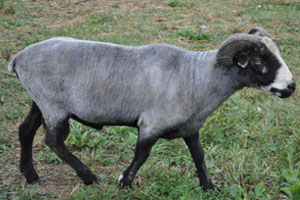
We bred our ewes to Baw Blue (or Blue as he’s commonly called) last year. Reese, our matriarch, “threw” Penny this past Spring.
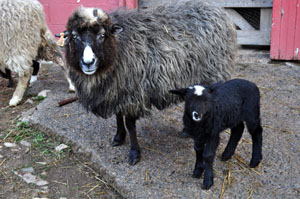
Reese and newborn Penny
Penny was born jet-black except for a little patch of white on her nose, crown, and very faint white “tears” (which I didn’t even notice until it came time to note her markings).
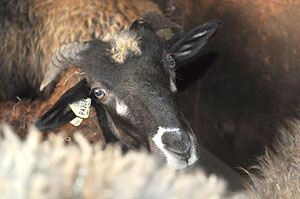
Penny Today
As Penny’s coat grew over the summer, she exhibited signs of black and brown in her wool. The color of churro wool will do that. It can change with age and bleach out with exposure to sunlight. Yet, when the shearer came last week??? What a lovely surprise! As her outer coat fell to the floor, her inner coat was a shimmering light gray-blue against her black legs and under-belly…matched with her distinct “tears” means she’s BLUE. English Blue to be precise.
Blue is the genetic color designation (which does not change) and will be noted on her registry paperwork. Her wool color will change with age and will also be noted on the paperwork — which will accompany a fleece sample from her shearing at one year of age.
[The following “Genetic Color Terms” courtesy of www.navajo-churrosheep.com]
Blue – Born black but in first year develop silver/charcoal inner coat while outer remains brownish/black. May develop white on eyes and muzzle but keep dark points, legs, body and belly are dark. Hips, sides are greyed.
English Blue – Must have white tears, may have white in ears or on muzzle. This is a pattern on Black or Brown.
Texel Blue – Resembles Badgerface. There is a dark bar over each eye, dark top of nose, dark under jaw on light face.
Why is this so special? It’s special because of the rarity of this particular color. The table shows, historically, less than one percent of the population of registered Churro possess this genetic color.
Navajo Churro Color Data – Past and Present
| Color | 1988 | 1998 | Avg. to Date |
| White | 45% | 27% | 34% |
| White/Tan | 4% | 6% | 7% |
| Black | 22% | 40% | 38% |
| Brown | 1% | 18% | 9% |
| Dark Brown | 2% | 2% | 1.7% |
| Grey | 12% | 4% | 4.5% |
| Grey/Tan | 2% | 0% | 0.6% |
| Blue | <1% | <1% | <1% |
| Badgerface | 3% | 10% | 3.6% |
| Black & Tan | 1% | 2% | 1.1% |
| Spots | 3% | 3% | 2.7% |
| Multi | 4% | 1% | 1% |
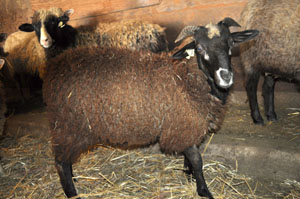
- Penny before shearing
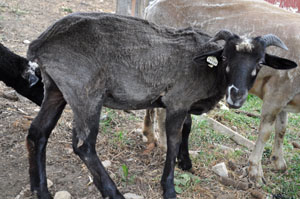
- Penny after shearing
I’m so thrilled to have this color combination in our flock—and to know it’s the matriarch’s ewe-lamb that has it. I can’t wait until Penny’s of “breed-able” age to see how her very special traits are passed on!
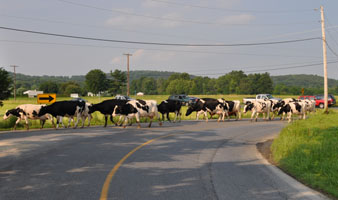 Every morning, a local dairy farmer leads his herd down the road to another pasture and then collects them in the evening to milk. If you time it just right, you get to watch the march—it’s special—only this time, it caught the school bus. I bet if Bob has to call the transportation office to explain the tardiness, not much of an excuse is needed.
 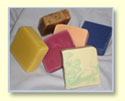 Every time I reach for my Pumice with Goat’s Milk soap I bought at Donna Howard’s Spotted Hill Farm, I marvel at the fact that the “special ingredient” came directly from her Mini-Nubians right in her own backyard!
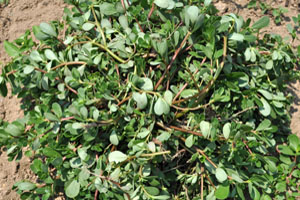 I didn’t always know Purslane, mind you. We met after I married.
 Lisa loves KWF and I love stopping to shop there! Established in 1986, KWF has grown to become the largest independent natural foods retailer in eastern Pennsylvania.
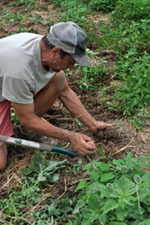 Red potatoes were ready to dig today! David gently forked the ground until it coughed up this variety of early/new potato, the Red Norland, which we planted about 100 days ago (days to maturity are always listed on your seed packet so that you may plan accordingly).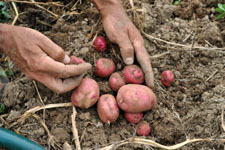
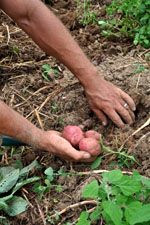
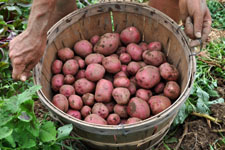 It’s a family favorite–so delicate and tender–and the skin gives way easily as you take bites.